

Design types and rod cross-sections
Since split cane rods have been manufactured, there have been different construction methods. It would actually be logical that different cross-sections result in different rod action characteristics.
Every company or rod builder is naturally convinced that their own method is the best.
Is that the case, or are we simply dealing with an interesting sales pitch?
A practical comparison with identical tapers has not existed in practice until now - for me, a reason to build such a rod series.


1 taper - 12 different constructions
Actually, it's quite normal: every rod builder is convinced that their rod construction method is the best – be it for aesthetic reasons or due to the rod's action type.
After countless unproductive discussions among rod builders, I decided to follow up the theoretical comparisons with practical testing: I chose to build a series of rods in which all common construction methods and cross-sections could be directly compared. Naturally, the entire series had to be based on an identical rod taper. With this in mind, I presented a series of 11 rods at the first Swiss rod builders' meeting in Sarnen in 2006, allowing for a direct comparison of their casting characteristics.
Three important decisions had to be made for this comparison series:
Which taper? | Which construction methods? | Which conversion factors?

Taper
Choosing the taper was relatively easy and, in principle, has no influence on the evaluation of a series: on the one hand, it had to be a taper that I like to cast (after all, I want to use the rods myself for fishing!) and on the other hand, it should be a relatively sensitive taper so that even small differences become visible or noticeable.
I chose one of my rod tapers, 7'3" in length, built for line class 4.
Construction
In my series, I wanted to compare different cross-sections of split cane rods, but also highlight differences in terms of hollow construction, ferrule types, and rod sectioning. The aim was to determine what influence each of these factors, always based on the same taper, has on the rod's action, and whether it is even perceptible.
Regarding the rod cross-section, rods with 4 (Quad) to 13 (Evo13) splices were built.
Regarding the ferrule connection , the rods were built with the most common NiSi sleeve, the Super Swiss, and this was then compared with the bamboo sleeve, three-piece rods (i.e., 2 sleeves), one-piece rods, and a spliced connection.
The hollow construction of the rods was done using three well-known methods: the Winston method (Lew Stoner, the Hollow Fluting), then Powell's Scalloping and finally the Norwegian Magic-Star method (Vangen).
The comparison regarding the effects of hollow construction, choice of ferrule, and spirally twisted rods was conducted within the group of rods with the traditional hexagonal construction. The aim was to demonstrate the extent to which hollow construction, targeted twisting of the rod, or a different ferrule joint influences the rod's action. Within this hexagonal group, no conversion factor was applied; all tapers are identical. Any difference in rod action or characteristics can therefore be directly attributed to the modified construction.


Conversion factor
A key decision was determining the basis for converting the individual rod cross-sections. Searching for solutions in various forums reveals differing factors, often tailored to individual needs. To ensure reproducibility, I chose a conversion method based on the rod's moment of inertia. The Italian rod builder Gabriele Gori has compiled these values in a comprehensive table, covering nearly all rod constructions.
His table ( Sezioni a compareo ) can be found on the IBRA (Italian Bamboo Rodmakers Association) website or here on my website.
In the same table, Gori also discusses different hollow construction methods.
Instructions for taking different ferrule types or hollow construction into account can also be found in some rod calculation programs such as iTaper, RodDNA, or Hexrod. However, as mentioned above, I didn't do this; I didn't want to compensate for the effect, but rather demonstrate it.
I converted all the different cross-sections of the fully constructed parts based on Goris' table.
The assessment
In the spring of 2014, I was invited to the Corbett Lake rod builders' meeting in Canada. There, I was to present this rod series. Due to space constraints, I reduced my line, which had grown to 16 rods in the meantime, to 12 rods, and it will be expanded further. It would have made little sense, for example, to transport a one-piece rod.
And there's one more thing to consider: to ensure a direct comparison of the rods, they must be identical in their accessories. In other words, all rods must be equipped with the same reels and fly lines!

The results from the practical comparisons during the casting of the rods are interesting. At the rod builders' meeting in Canada, more than 35 casters shared their impressions and evaluations of the rods with me. A clear majority rated my new Evo8 as the best in terms of casting performance. This rod was a new addition to the series; it was missing from older comparisons. The hollow-built Hex, the Evo6, the Quad, and the Penta were the next most popular. Almost all the rods found a fan; only the thirteen-spliced Evo13 received no positive mention. This result is certainly subjective and reflects personal preferences or desires, always also dependent on the casting skills of the individual caster.
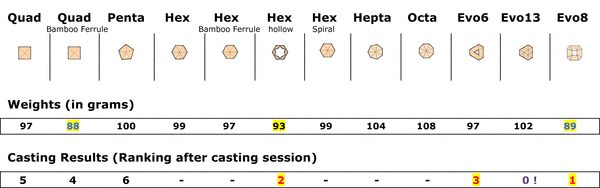
While casting performance is quite individual and certainly influenced by subjective aesthetic criteria, the weight differences of the rods are clearly measurable. Nevertheless, they require explanation:
-
The Quad rods (and also the Evo8 with a comparable cross-section) are essentially the lightest. The significant difference between the NiSi ferrule and the bamboo ferrule is striking. The entire rod series was built using the Super-Swiss type, with one exception: the Quad! For aesthetic and practical reasons, I use step-down ferrules (Jeff Wagner system) on Quad rods. These are considerably heavier, especially compared to the bamboo ferrule and the Hex Hollow.
-
The Evo8, a modified quad design with respect to its cross-section, is one of the lightest rods in the series, despite being equipped with NiSi ferrules, due to its hollow construction. It also features Super Swiss ferrules, making it directly comparable in weight to all other rods in the series.
-
I have no explanation whatsoever for the slightly higher weight of the Penta, which should actually be lighter than a Hex.
The results from the practical comparisons during the casting of the rods are interesting. At the rod builders' meeting in Canada, more than 35 casters shared their impressions and evaluations of the rods with me. A clear majority rated my new Evo8 as the best in terms of casting performance. This rod was a new addition to the series; it was missing from older comparisons. The hollow-built Hex and the Evo6, followed by the Quad and Penta, were next in line. Almost all the rods found a fan; only the thirteen-spliced Evo13 received no positive mention. This result is certainly subjective and reflects personal preferences or desires, always also dependent on the casting skills of the individual caster.
-
The results from the practical comparisons during the casting of the rods are interesting. At the rod builders' meeting in Canada, more than 35 casters shared their impressions and evaluations of the rods with me. A clear majority rated my new Evo8 as the best in terms of casting performance. This rod was a new addition to the series; it was missing from older comparisons. The hollow-built Hex, the Evo6, the Quad, and the Penta were the next most popular. Almost all the rods found a fan; only the thirteen-spliced Evo13 received no positive mention. This result is certainly subjective and reflects personal preferences or desires, always also dependent on the casting skills of the individual caster.
While casting performance is quite individual and certainly influenced by subjective aesthetic criteria, the weight differences of the rods are clearly measurable. Nevertheless, they require explanation:
-
The Quad rods (and also the Evo8 with a comparable cross-section) are essentially the lightest. The significant difference between the NiSi ferrule and the bamboo ferrule is striking. The entire rod series was built using the Super-Swiss type, with one exception: the Quad! For aesthetic and practical reasons, I use step-down ferrules (Jeff Wagner system) on Quad rods. These are considerably heavier, especially compared to the bamboo ferrule and the Hex Hollow.
-
The Evo8, a modified quad design with respect to its cross-section, is one of the lightest rods in the series, despite being equipped with NiSi ferrules, due to its hollow construction. It also features Super Swiss ferrules, making it directly comparable in weight to all other rods in the series.
-
I have no explanation whatsoever for the slightly higher weight of the Penta, which should actually be lighter than a Hex.
The results from the practical comparisons during the casting of the rods are interesting. At the rod builders' meeting in Canada, more than 35 casters shared their impressions and evaluations of the rods with me. A clear majority rated my new Evo8 as the best in terms of casting performance. This rod was a new addition to the series; it was missing from older comparisons. The hollow-built Hex and the Evo6, followed by the Quad and Penta, were next in line. Almost all the rods found a fan; only the thirteen-spliced Evo13 received no positive mention. This result is certainly subjective and reflects personal preferences or desires, always also dependent on the casting skills of the individual caster.
-